Are Business Cards a Waste of Money?
February 28, 2026 • Updated 1 day, 3 hours ago
You've probably ordered business cards at least once. Maybe you spent $30 on a basic pack from an online printer. Maybe you went premium — thick stock, spot UV, rounded corners — and dropped $150 or more. Either way, you walked out of the print shop feeling prepared.
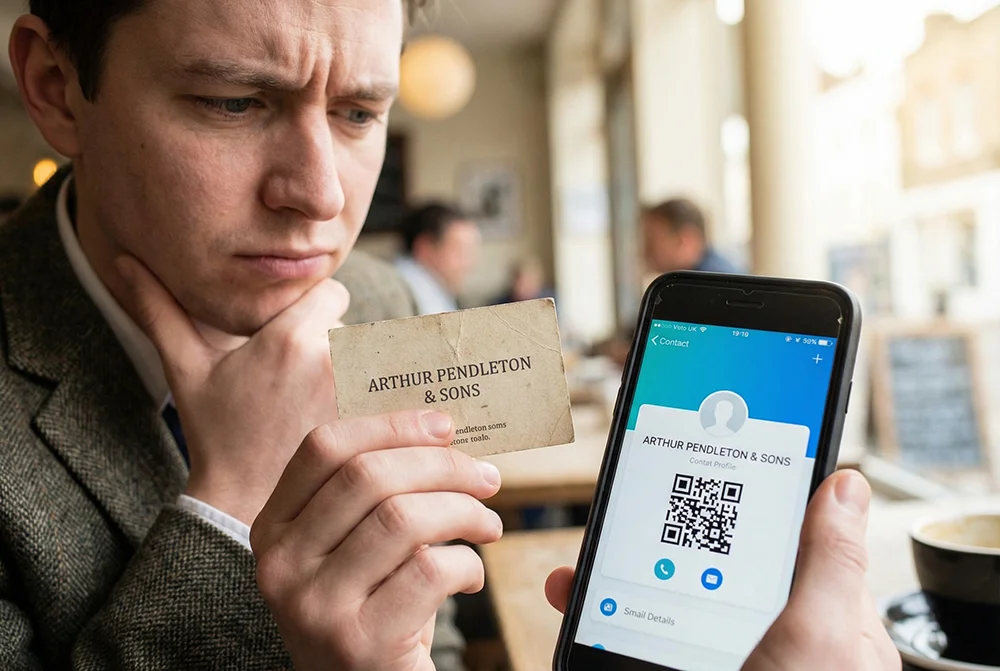
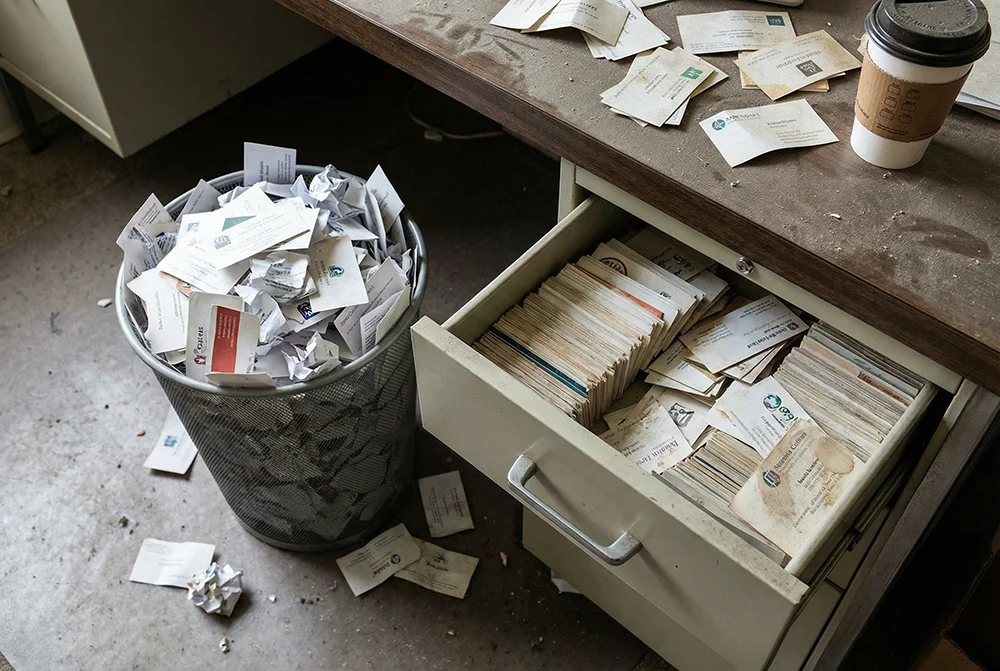
Fast forward six months. How many of those cards actually turned into a client, a deal, or even a saved contact? If you're being honest, probably very few. Most of them ended up in desk drawers, jacket pockets, or trash cans — yours and theirs.
So are business cards a waste of money? The answer isn't a simple yes or no. It depends on what kind of cards you're using, how you're using them, and whether there's a better option for what you're actually trying to accomplish.
Let's break it down honestly.
The real cost of paper business cards
On the surface, business cards seem cheap. A basic pack of 250 cards might run $20 to $40. But that sticker price hides the full cost of relying on paper cards as your primary networking tool.
Design costs. Unless you're using a generic template, you need someone to design the card. A freelance designer might charge $50 to $200 for a professional business card layout. If you're particular about your brand, this adds up — especially when you redesign after a job change, promotion, or rebrand.
Reprinting costs. Every time your phone number, email, job title, or company changes, the entire batch is obsolete. You can't edit a printed card. You throw them away and order new ones. Over the course of a career, most professionals go through five to ten rounds of reprints. That's not $30 — it's $300 to $500 over time, plus the design revisions.
Premium upgrades. If you want cards that actually stand out — letterpress, metal, wood, embossed, foil stamped — you're looking at $1 to $5 per card. A box of 100 premium cards can easily cost $200 to $500. They look incredible. They also get thrown away at the same rate as the cheap ones.
The hidden cost: waste. Studies on business card usage consistently show that 88% of paper business cards are thrown away within a week of being received. That means for every 100 cards you hand out, roughly 88 end up in the trash. You're not just spending money on cards — you're spending money on cards that almost nobody keeps.
Shipping and time. Online printers take 5 to 10 business days for standard delivery. Need them for an event next week? Rush shipping costs extra. Ran out at the conference? You're stuck introducing yourself without one. The logistics of keeping physical cards stocked and available is a minor but constant friction.
What paper business cards actually do well
It's not all bad. Paper business cards do have legitimate strengths, and dismissing them entirely would be dishonest.
Tangible first impression. A well-designed paper card makes a physical impression that a digital exchange doesn't. The weight of the stock, the texture of the finish, the quality of the print — these things communicate professionalism in a way that's hard to replicate on a screen. In certain industries like luxury goods, high-end real estate, or creative fields, a premium card is part of the brand experience.
Universal familiarity. Everyone knows how business cards work. There's no learning curve, no technology requirement, no "do you have an iPhone?" barrier. You hand it over, they take it. Simple.
Cultural expectations. In some business cultures — particularly in Japan, South Korea, China, and parts of Europe — the exchange of physical business cards is a ritual with specific etiquette. In these contexts, not having a paper card can be seen as unprofessional or disrespectful.
No battery required. Your paper card works when your phone is dead, when there's no WiFi, and when the other person isn't tech-savvy. It has zero dependencies.
Where paper business cards fall short
The strengths of paper cards are real, but they're increasingly outweighed by practical limitations that didn't matter 20 years ago but matter a lot now.
They don't get saved. This is the fundamental problem. Handing someone a card and getting your contact info into their phone are two very different things. Most people receive a card, put it in their pocket, and never transfer the information to their phone. The card might sit on their desk for a week before it gets tossed. Your contact info never makes it into their address book, which means when they think "I should reach out to that person I met," they can't find you.
They can't be updated. You get promoted. You change companies. You switch to a new email. Every paper card you've ever handed out now has wrong information on it. There's no way to recall or update them. The person who saved your card six months ago now has a dead phone number.
They provide zero data. When you hand out 200 cards at a trade show, you have no idea how many people actually looked at your info, visited your website, or saved your contact. There's no tracking, no analytics, no way to measure whether your cards are working or just filling trash cans.
They create friction in the follow-up. After an event, you're stuck manually typing in names and emails from a stack of cards. That data entry bottleneck means follow-ups get delayed — and delayed follow-ups are dramatically less effective. We covered this in detail in our guide on how to follow up after a networking event.
They run out. It always happens at the worst time. You're at a great event, making connections, and you reach into your pocket and realize you're out of cards. Or you brought 20 and the event had 200 attendees. Physical inventory is a limitation that digital doesn't have.
The digital business card alternative
A digital business card solves most of the problems that make paper cards wasteful — without sacrificing the core function of sharing your contact information quickly and professionally.

Instant contact saving. When someone scans your QR code or taps your digital card link, your full contact details — name, phone, email, company, website, social links, photo — save directly to their phone. No manual entry. No card sitting in a pocket. Your info is in their address book within seconds. For the full walkthrough, see how to share your contact info with a QR code.
Always up to date. Change your job title? Update your card once and everyone who has your link sees the new info automatically. No reprinting. No outdated cards floating around with your old phone number. One card, always current.
Never runs out. Your digital card lives on your phone. You can share it with 5 people or 500 people at the same event. There's no inventory to manage, no print runs to time, and no "sorry, I'm out of cards" moments.
Trackable. A digital business card platform like vCard Garden shows you how many people viewed your card, when they viewed it, and what actions they took. This turns networking from a guessing game into something you can actually measure and improve.
Professional and customizable. Digital cards aren't just plain text files. A well-designed digital card includes your photo, branding, social links, and a clean layout that looks as professional as any printed card — often more so. You can choose templates that fit your industry and style.
Multiple sharing options. QR code, shareable link, NFC tap, email signature, text message, social media bio — you can share your digital card in whatever way fits the moment. We compared the main sharing methods in our NFC vs QR code business cards guide.
What about using both?
Here's the pragmatic answer that most people land on: use both, but let digital do the heavy lifting.
Carry a small number of paper cards for situations where they're culturally expected or where the other person clearly prefers physical exchange. But make your digital card your primary tool for actually getting your contact info saved.
Some people even print a QR code on their paper business card — combining the tactile experience of handing over a physical card with the digital advantage of instant contact saving. The recipient gets a card they can keep and a QR code that saves your info to their phone immediately. It's the best of both worlds.
The key shift is this: stop thinking of the paper card as the thing that captures the contact. Think of it as a conversation starter or a physical reminder. The digital card is what actually gets your info into their phone and keeps it up to date.
The real math: paper vs digital costs
Let's put real numbers on this.
Paper business cards over 3 years:
Initial design: $75 to $150. First print run (500 cards): $40 to $80. Reprint after job change (year 1): $40 to $80. Reprint after new phone number (year 2): $40 to $80. Premium upgrade for a big conference: $150 to $300. Rush shipping (at least once): $25 to $50. Total over 3 years: roughly $370 to $740 — and 88% of those cards end up in the trash.
Digital business card over 3 years:
Most digital card platforms cost between $0 and $10 per month depending on the plan. Even at the higher end, that's $360 over three years — with unlimited sharing, instant updates, tracking data, and zero waste. At the lower end or with a free tier, it's significantly less.
The digital option is comparable or cheaper in cost, but dramatically more effective at the one thing business cards are supposed to do: get your contact information saved by the people you meet.
So are business cards a waste of money?
Paper-only business cards? For most people, yes — they're an expensive habit with a terrible conversion rate. You're paying to print something that almost nobody saves. The money isn't the biggest waste — it's the lost connections. Every card that gets thrown away is a relationship that never started.
Digital business cards? No. They cost less, do more, stay current, and actually accomplish the goal of getting your info into people's phones. They're the better investment for anyone who networks regularly.
Paper cards with a QR code? A smart hybrid. You get the physical presence of a traditional card with the digital functionality that actually saves contacts. If you're going to spend money on printed cards, at least make sure they include a QR code that links to your digital card.
Get started with a digital business card
If you're tired of spending money on cards that end up in the trash, try the alternative. Create your free vCard Garden card and get a shareable link, QR code, and downloadable contact file in under 5 minutes.
Update it anytime. Share it with anyone. Know exactly who's viewing your card. And never run out at a conference again.
Start your free trial — your digital business card is ready in minutes.
Related Resources
- How to Follow Up After a Networking Event (Without Losing Contacts)
- How to Create a Digital vCard for Professional Networking
- How to Share Your Contact Info with a QR Code
- NFC vs QR Code Business Cards: Which Is Better?
- Digital Business Card for Realtors: Why Every Agent Needs One
- What is a vCard? Everything You Need to Know