Digital Business Cards
You handed out 50 cards last month. How many turned into saved contacts? A digital business card puts you in their phone — not their junk drawer.
Every card comes with a QR code, a one-tap contact download that saves your info directly to their phone, and tracking so you can see exactly who viewed your page, when, and from where.
What Happens When Someone Scans Your QR Code
They land on a single page with everything they need. Here's what they see as they scroll through it:

Your profile, front and center
The first thing they see is your photo, name, title, and company — plus your company logo if you have one. Below that is your bio, so they immediately know who you are and what you do.
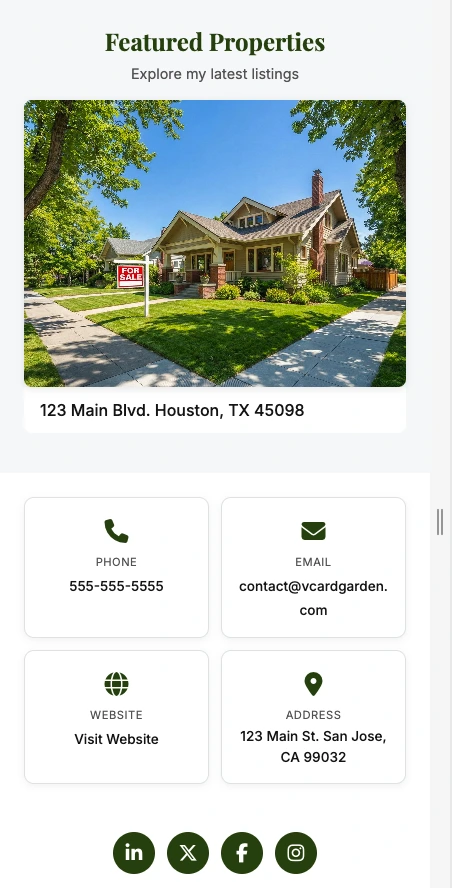
Your work and contact info, all tappable
Scrolling down, they see your industry-specific content — property listings for realtors, portfolio pieces for freelancers, project photos for contractors. Phone, email, website, and address are all one tap away. Social links sit at the bottom.
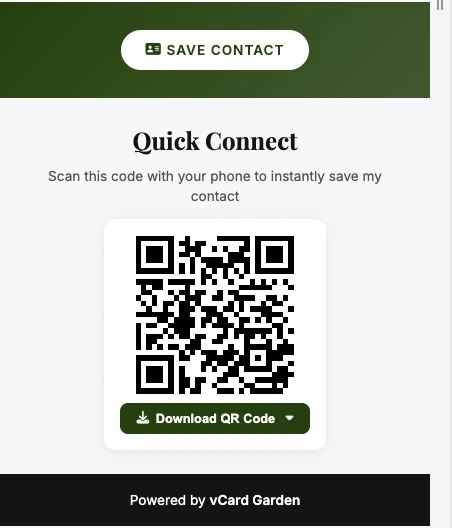
One tap and they have your number
At the bottom is a "Save Contact" button. One tap downloads a .vcf file — the standard format every phone understands — and your name, number, email, and company go straight into their address book. There's also a QR code they can share with someone else.
Changing Your Info Shouldn't Be a Project
Got a new phone number? Switched brokerages? Added a certification? You're not calling a designer or rebuilding anything. You're editing a form — the same kind you've filled out a thousand times.
Change a field, hit save, and your live page updates instantly. The QR code you printed on 500 business cards last month? Still works. It points to your page, not to your old info.
Five templates built for specific industries: real estate, coaching, freelance, contracting, and small business. Each one has sections designed for that line of work — property listings for realtors, portfolio galleries for freelancers, project photos for contractors.
Try the Preview →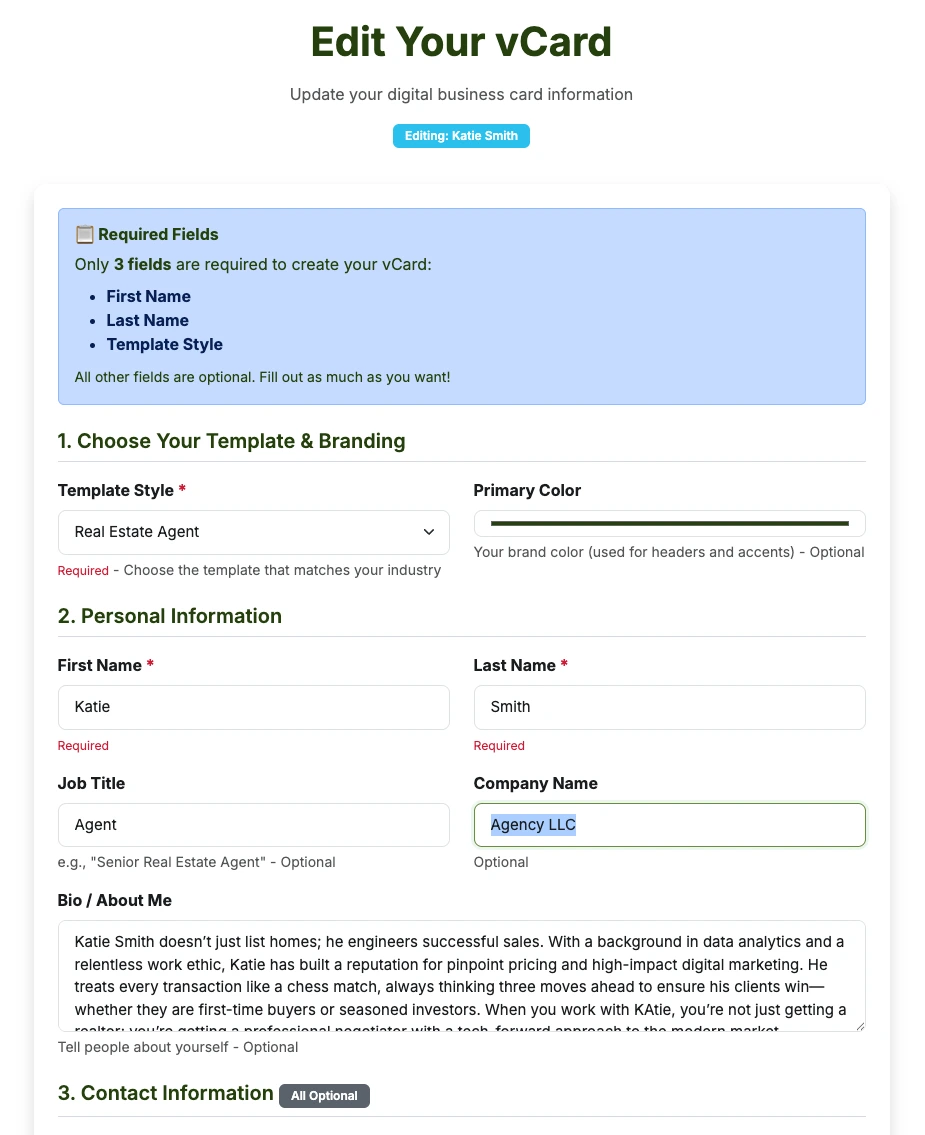
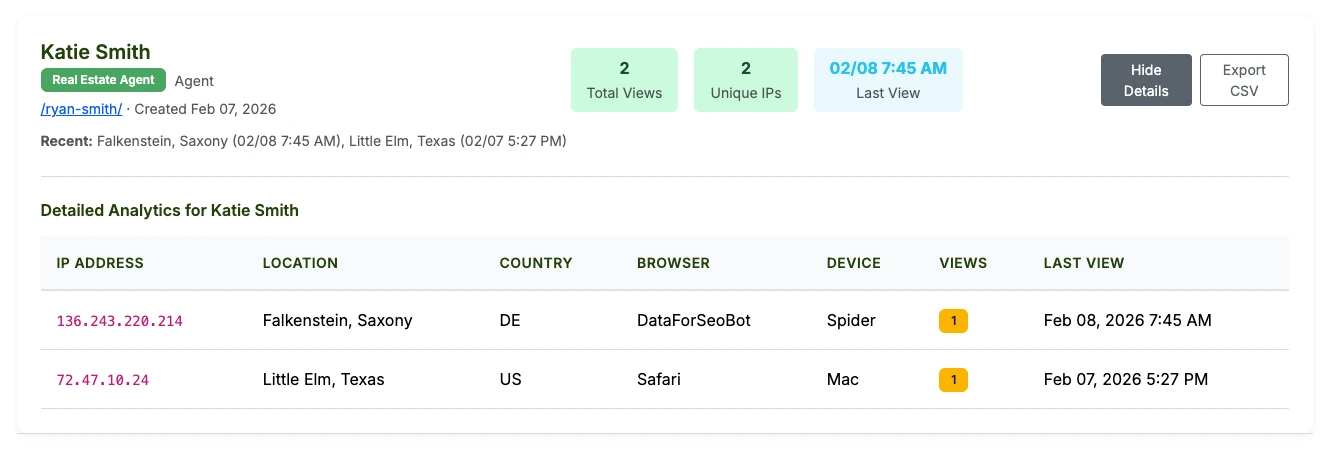
Know Who's Looking at Your Card
Paper cards vanish into pockets. You never find out if someone actually looked at your info or threw it away at the end of the night.
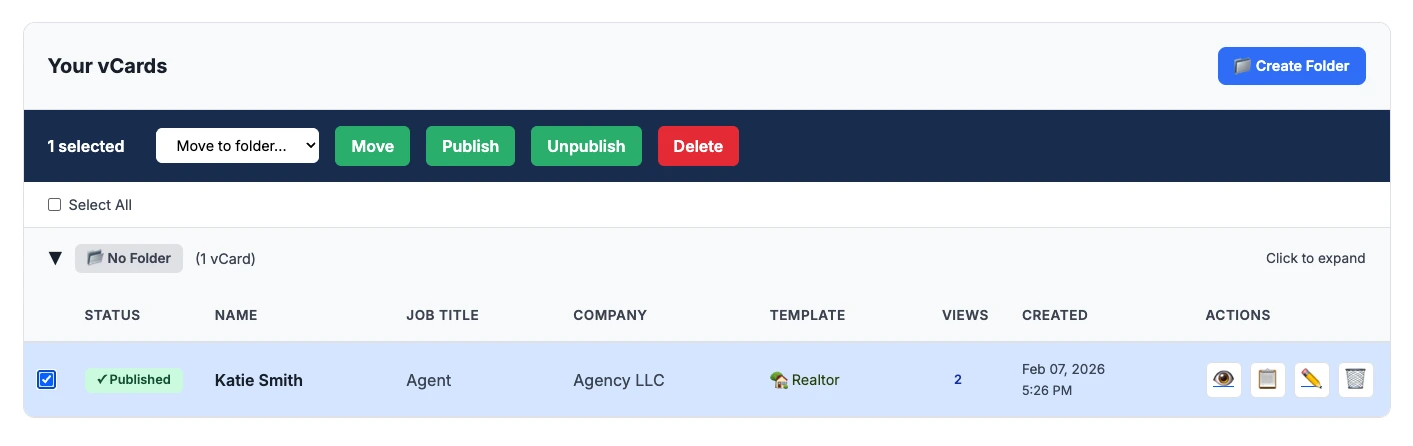
Every time someone opens your page, you see it: total views, unique visitors, what city they're in, what browser and device they used, and the exact time they looked. If you need the raw data, export it to CSV in one click.
Hand out ten QR codes at a conference and actually know how many people followed through.
This Isn't Replacing Your Website
You probably already have a website. That's not what this is for.
A digital business card is the thing you hand to someone when you meet them face to face. It's the QR code on your yard sign, the link in your email signature, the thing you text someone after a conversation so they can save your number without asking you to spell your last name twice.
Your website is for search engines. Your digital business card is for people standing in front of you.
No App. No NFC Card. No Hardware.
Most digital business card companies want you to buy a physical NFC card, download their app, and somehow convince the person you're meeting to download it too. That's not simpler than paper — it's a worse version of the same problem.
| Feature | vCard Garden | Popl / HiHello / Linq |
|---|---|---|
| Works in any browser | ✅ Yes | Often requires app |
| Recipient needs an app | No | Sometimes yes |
| Requires NFC card purchase | No — just a link or QR | $20–$40+ per card |
| One-tap contact save | ✅ .vcf download | Varies by platform |
| Built-in analytics | ✅ Included | Often a paid add-on |
| Industry-specific templates | 5 templates | Generic layouts |
| Starting price | $9/mo | $7.99/mo + hardware |
vCard Garden is a web page. Anyone with a phone can view it, save your contact, and move on with their day.
Why People Are Leaving Paper Cards Behind
Think about the last conference or networking event you went to. You probably picked up a dozen cards, shoved them in your pocket, and forgot about most of them by Monday. The people you handed yours to did the exact same thing.
It's not a discipline problem — it's a format problem. A small piece of cardstock with eight-point font isn't how anyone actually saves a contact anymore. People save contacts on their phone. If your card doesn't get into their phone, it doesn't get saved at all.
Then there's the time. You change jobs, get a new number, move offices — now every card you handed out is wrong. Reordering takes days, costs $30–50 a box, and you're back to square one. Multiply that by a couple changes a year and it adds up fast, both in money and in the hours you spend dealing with it.
A digital card sidesteps the whole cycle. Build it once, change it whenever, and every QR code and link you've ever shared automatically shows the updated info.
Frequently Asked Questions
See It for Yourself
Try a preview in 2 minutes. No account needed, no credit card.
Plans start at $9/mo · See pricing