NFC vs QR Code Business Cards: Which Is Better?
February 13, 2026 • Updated 2 weeks, 2 days ago
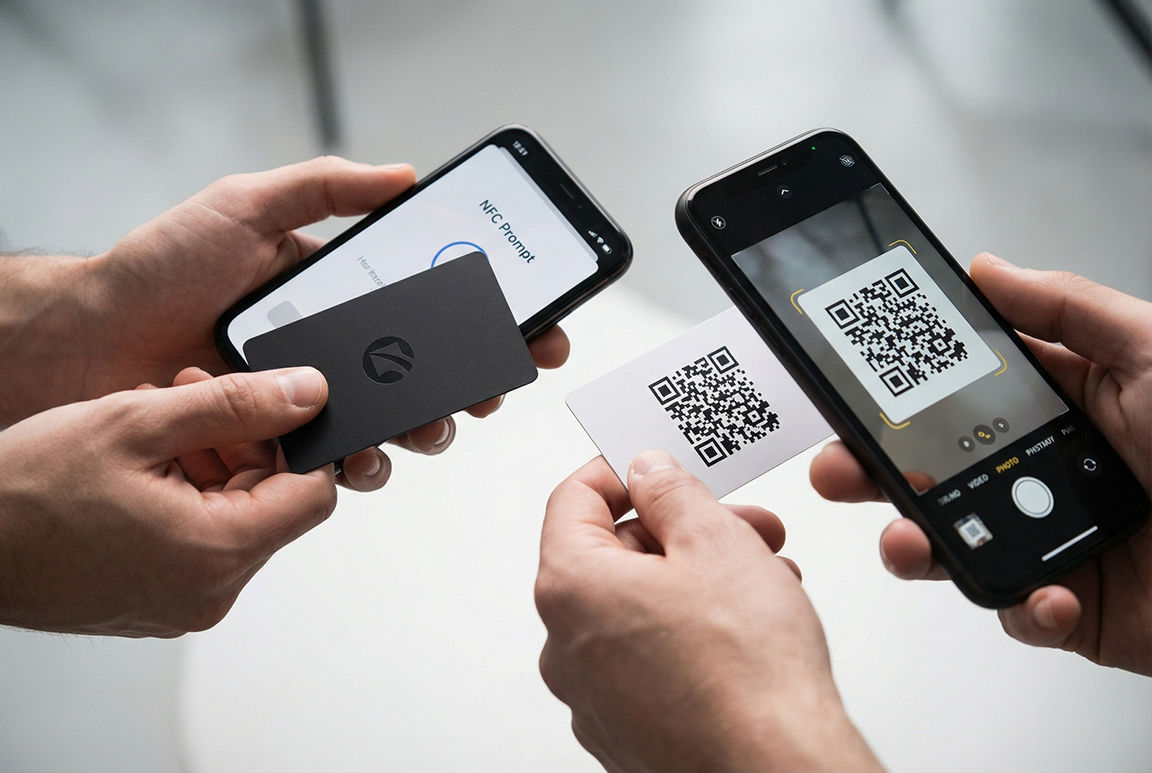
Two ways to go digital
If you're replacing paper business cards with something digital, you've probably seen two options: NFC cards and QR code cards. Both get your contact info onto someone's phone without typing. But they work differently, cost differently, and one is a lot simpler to set up than the other.
Here's the honest breakdown.
How NFC cards work
NFC stands for Near Field Communication. An NFC business card has a small chip embedded inside it. When someone taps the card against their phone, the chip sends a signal that opens a link — usually to your contact page or digital business card.
No camera needed. No scanning. Just tap and go.
Sounds great, but there are catches.
How QR code cards work
A QR code business card works differently. The card has a printed QR code on it. Someone points their phone camera at it, and it opens your digital business card page. From there they tap "Save Contact" and your info goes straight into their phone.
It takes a few seconds longer than NFC, but it works on every smartphone made in the last decade.
The real differences
Compatibility. This is the big one. About 87% of smartphones support NFC. That means roughly 1 in 8 people you hand your card to can't use it. QR codes work on virtually 100% of smartphones — every iPhone and Android has a camera that reads QR codes built in.
Cost. NFC cards cost $20 to $150 each depending on the material — plastic, metal, or wood. A QR code can be printed on any card for pennies, or displayed on a screen for free.
Speed. NFC is faster — under one second. QR scanning takes 3 to 5 seconds. In practice, both feel instant.
Range. NFC requires the card to physically touch or nearly touch the phone. QR codes can be scanned from a few feet away. This matters for signage, presentations, name badges, and anywhere you can't hand someone a card.
Sharing remotely. You can screenshot a QR code and text it to someone. You can put it in an email signature or on a slide deck. NFC only works in person, within inches.
Setup complexity. NFC cards need to be purchased, programmed with an app, and the chip encoded with your URL. QR codes are generated automatically when you create a digital business card — no extra hardware, no programming.
When NFC makes sense
NFC cards work well if you want a premium feel at in-person meetings. Handing someone a metal card and saying "just tap it" makes an impression. If you're in sales, real estate, or finance and you meet people face-to-face regularly, the wow factor can be worth the cost.
But you should still have a QR code as backup for the people whose phones don't support NFC.
When QR codes make more sense
For most people, QR codes are the practical choice. They work everywhere, cost nothing extra, and don't require special hardware. You can use them in person, online, on printed materials, in presentations, and on signage — places NFC simply can't reach.
If you want to get your digital business card set up quickly without dealing with chips, apps, or programming, QR codes are the way to go.
What actually matters: the page behind the code
Here's the thing most comparison articles skip — whether you use NFC or QR, both just open a link. The link is what matters. If it goes to a clunky page that doesn't let people save your contact easily, neither technology helps.
What you actually need is a clean, mobile-friendly page that loads fast and lets someone save your info with one tap. That's the part that turns a scan into a saved contact.
How vCard Garden handles this
vCard Garden gives you a digital business card page with a QR code built in. No coding, no design work, no complicated setup. You fill out a form, pick a template, and you're online in minutes.
Every page includes:
- One-tap "Save Contact" button that downloads your info as a phone contact
- QR code generated automatically — download it for print or screen
- Clickable phone, email, and website links
- Your photo and company logo
- Social media links
- Built-in analytics so you can see who's viewing your card
- Edit anytime — your link and QR code stay the same
No NFC chip to buy. No app to program. Just a page that works.
The bottom line
NFC is cool. QR codes are practical. If budget isn't an issue and you network in person constantly, get both — an NFC card with a QR code printed on it covers everyone.
But if you want to get set up fast and reach the widest audience, start with a QR code. It's free, it's universal, and it works everywhere NFC can't.
Create your digital business card — QR code included, live in under 5 minutes.